Tax-loss harvesting: the complete guide (including when it's not worth it)

Tax-loss harvesting: the complete guide (including when it's not worth it)
Tax-loss harvesting: the complete guide (including when it's not worth it)
In this article
You’ve probably heard that tax-loss harvesting can save you thousands in taxes every year. That’s true — up to a point. Vanguard research shows that tax-loss harvesting delivers 0.47% to 1.27% in gross annual tax alpha over a 15-year period. But here’s what most sources won’t tell you: J.P. Morgan’s research reveals that 80% of those benefits are front-loaded into the first five years. After that, the value decays sharply. This matters because it changes everything about whether harvesting is worth the complexity — especially if you’re considering a robo-advisor that charges 0.25% annually for the service.
By the end of this guide, you’ll understand exactly how tax-loss harvesting works, when it’s genuinely valuable, when it’s not, and what pitfalls can accidentally trigger wash sale violations across your multiple accounts. You’ll know whether DIY harvesting or automated robo-advisor harvesting makes sense for your portfolio size. Most importantly, you’ll be able to evaluate the trade-offs with real numbers and sourced data.
What Tax-Loss Harvesting Delivers
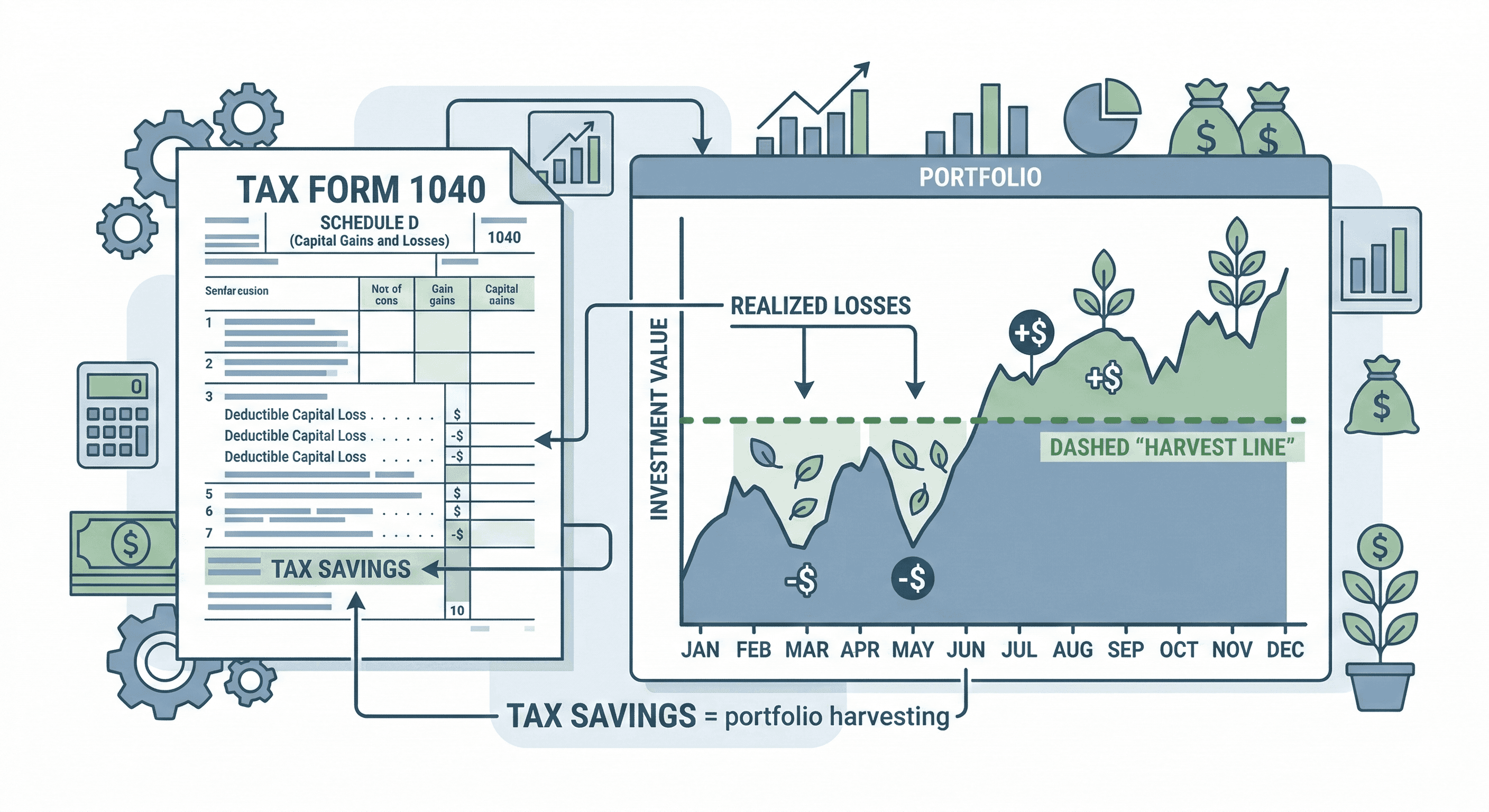
Tax-loss harvesting is a real strategy that works. When you harvest a loss, you’re selling an investment that’s declined in value, using that loss to offset capital gains from elsewhere in your portfolio, and then immediately buying a replacement investment that’s similar but not "substantially identical" (we’ll define that carefully in a moment). The result: you reduce your taxable income, lower your tax bill, and stay invested in essentially the same portfolio.
Here’s the math that makes it work: Imagine you have a $100,000 portfolio with 10% harvestable losses (a conservative estimate — losses tend to cluster around 5–15% depending on market conditions). Your harvestable losses total $10,000. If you’re in a 25% tax bracket (standard for mid-to-high earners), harvesting that loss saves you $2,500 in taxes that year. For a household earning $200K+ and subject to the 3.8% Net Investment Income Tax (NIIT), the effective tax rate on capital gains can reach 23.8%, making the same $10,000 loss worth $2,380 in savings.
This isn’t theoretical. Parametric Portfolio Associates, which specializes in direct indexing (a more granular version of tax-loss harvesting), harvested $8.8 billion in losses for clients in 2025 — demonstrating that this strategy operates at institutional scale and isn’t a niche tactic.
Why this matters beyond the year you harvest
The reason tax-loss harvesting is worth understanding is that it reduces your drag in taxable accounts. Over a 15-year period, the cumulative effect adds up. A portfolio that harvests losses systematically will have meaningfully more wealth than an identical portfolio that doesn’t — especially if you’re a high earner generating short-term capital gains (from incentive stock options, RSU vesting, or active trading). Short-term gains are taxed as ordinary income, reaching 37% for top earners, compared to long-term capital gains rates of 15–20%. For those investors, tax-loss harvesting can be the difference between keeping $6,300 and keeping $6,800 on a $10,000 gain — a meaningful advantage over decades.
But — and this is critical — the benefit isn’t linear. This is where the research gets more nuanced than the headline figures suggest.
How tax-loss harvesting works (and the rules that govern it)
To harvest losses effectively, you need to understand the mechanics and, more importantly, the constraints.
The Step-by-Step Mechanic
Here’s exactly how harvesting works:
Identify a loss. You own SPY (an S&P 500 ETF) that you bought at $100/share. It’s now trading at $85/share. You have a $15/share loss, or $1,500 loss per 100 shares.
Sell at the loss. You sell your 100 shares of SPY, realizing the $1,500 loss. This loss is now available to offset capital gains from other investments.
Buy a replacement. You immediately purchase a different (but similar) investment — perhaps VOO (Vanguard’s S&P 500 ETF) or IVV (iShares’ S&P 500 ETF). The new investment tracks the same index as SPY, giving you the same market exposure, so you don’t miss the recovery.
Offset gains. If you have $5,000 in capital gains from selling Apple stock earlier in the year, you use the $1,500 loss to offset $1,500 of those gains. You now owe taxes on $3,500 of gains instead of $5,000.
Carry forward unused losses. If your loss exceeds your gains, you can deduct up to $3,000 of losses against ordinary income (per IRS §1211). Any excess carries forward indefinitely to future years. So if you harvested $50,000 in losses, you’d deduct $3,000 this year, $3,000 next year, and so on for about 16+ years.
The $3,000 Annual Deduction Cap
This is the first constraint most people miss. You can only deduct $3,000 of net losses against ordinary income per tax year (or $1,500 for married filing separately). This means if you have a large portfolio with significant losses, the benefit is spread across many years. On a $50,000 harvestable loss at a 25% tax rate, the total tax benefit is $12,500 — but you only realize $750/year ($3,000 × 25%) until you’ve used up the loss.
This is why TLH is more valuable for young savers with growing portfolios than for retirees in drawdown mode. A retiree might realize $50,000 in harvestable losses from a market decline but get no tax benefit that year (if they have no capital gains). A high-income earner with $200K of annual capital gains can harvest losses and realize the benefit immediately.
Tax-loss harvesting sounds straightforward — sell a loser, buy a replacement, pocket the tax savings. But two rules turn a simple concept into a minefield for unprepared investors: the wash sale rule and the $3,000 annual deduction cap.
The wash sale rule: What nobody tells you
The wash sale rule is the reason most DIY tax-loss harvesting attempts fail — and also the reason robo-advisors and direct indexing firms exist.
The Rule, Explained Clearly
The wash sale rule (IRS §1091) is simple in principle: you cannot deduct a loss if you buy a substantially identical security within 30 days before or 30 days after the sale.
This creates a 61-day window: 30 days before the sale + the sale day + 30 days after.
Example: You sell SPY on January 10. You cannot buy SPY or a substantially identical fund from January 11 through February 9 (30 days after). If you do, the IRS disallows the loss, and the original purchase cost is added back to the new purchase’s cost basis.
The cross-account trap (the #1 unintentional error)
Here’s where most people stumble: the wash sale rule applies across ALL accounts — not just the account where you sold.
This means:
You sell SPY in your brokerage account to harvest a loss
Your spouse (in their IRA) accidentally buys SPY the next day
Wash sale violation. The IRS disallows the loss.
Or:
You sell SPY in your taxable account
You rebalance your IRA by buying SPY (because you had some cash sitting there)
Wash sale violation.
This is the #1 unintentional wash sale trigger. Without account aggregation (a unified view of all your holdings), it’s nearly impossible to track across multiple institutions, especially if you have:
A brokerage account at Fidelity
An IRA at Vanguard
A spouse’s IRA at Schwab
A 401(k) at your employer
Tax professionals estimate that 25–35% of DIY TLH practitioners trigger wash sales unintentionally, most often across multiple accounts.
The "Substantially Identical" Ambiguity
Here’s the thorny part: the IRS has never formally defined "substantially identical" for ETFs.
That SPY-to-VOO swap we mentioned? Both track the S&P 500. Both have >99% return correlation. Are they substantially identical?
Tax professionals generally apply a >95% return correlation standard as a safety threshold. Most tax advisors recommend diversifying fund families as a practical protection (buying from a different issuer like Vanguard instead of State Street). But there’s no regulatory bright line.
What this means for you: If you’re doing DIY TLH, you need to be conservative. Swap SPY (State Street S&P 500) for VOO (Vanguard S&P 500) and document your reasoning. Better yet, consult a tax professional if you harvest more than $5,000 in losses in a given year.
Why this complexity drives people to robo-advisors
Robo-advisors like Wealthfront and Betterment automate this tracking. They monitor all connected accounts and prevent wash sale violations by:
Flagging when you’re about to buy a substantially identical security
Tracking your entire account ecosystem (if you’ve connected multiple institutions)
Automatically substituting different ETFs if needed
More critically, tools with account aggregation capability can track your positions across all your brokers simultaneously — preventing the cross-account wash sale trap that snares 25–35% of DIY practitioners. Truthifi’s account aggregation platform (see features), for example, monitors positions across an average of 7+ accounts per household with 99.7% data accuracy — the kind of unified visibility that makes cross-account wash sale prevention tractable.
For an investor with $50K–$500K across multiple accounts, this automation prevents costly IRS penalties and lost deductions. It’s not the only reason to use a robo-advisor, but it’s a real one.
When tax-loss harvesting makes sense — and when it doesn’t
Here’s where the benefit curve becomes more nuanced than the headline figures suggest. Tax-loss harvesting is a real benefit — but only under certain conditions. And for many investors, those conditions don’t hold.
The Benefit Decay Curve
Vanguard’s research (0.47–1.27% annual benefit) is the headline figure everyone cites. But it’s a long-term average that masks a crucial reality: most of the benefit shows up in the first five years, then decays sharply.
J.P. Morgan’s analysis of actual portfolio data shows that nearly 80% of the cumulative tax savings from TLH are realized within the account’s first five years. After that, the opportunity to harvest new losses decreases because:
You’ve already harvested most of the losses from the initial portfolio construction
Long-held positions have higher cost bases, so losses are less frequent
The account needs continuous new contributions to maintain harvestable opportunities
Here’s what that decay looks like, using a $100,000 portfolio with 10% initial harvestable losses:
Year | Annual Tax Benefit | Cumulative % |
|---|---|---|
Year 1 | $2,000 | 50% |
Year 2 | $1,000 | 75% |
Year 3 | $500 | 87% |
Year 4 | $250 | 93% |
Year 5 | $150 | 96% |
By year 5, you’ve captured 96% of the benefit. Years 6–10 contribute almost nothing.
This matters enormously because robo-advisors charge 0.25% annually. On a $100,000 portfolio, that’s $250/year forever. Over five years, that’s $1,250 in fees. Your cumulative TLH benefit? Roughly $3,850. Net benefit: $2,600. But expand the timeline: year 6–10, you’re paying $250/year while realizing $50/year in TLH benefit. You’re paying more for the service than you’re getting back.
The portfolio size break-even
Here’s the real question: At what portfolio size does robo TLH’s fee become justified?
Spoiler: It doesn’t. Not because robo-advisors are bad — they’re not — but because TLH alone doesn’t pay for the 0.25% advisory fee.
Let’s work through the math with five-year windows:
Portfolio Size | Year 1 TLH Benefit | Robo Fee (5 years) | Cumulative TLH (5 years) | Net Benefit |
|---|---|---|---|---|
$50,000 | $1,250 | $6,250 | $3,500 | -$2,750 |
$100,000 | $2,500 | $12,500 | $7,000 | -$5,500 |
$250,000 | $6,250 | $31,250 | $17,500 | -$13,750 |
$500,000 | $12,500 | $62,500 | $35,000 | -$27,500 |
$1,000,000 | $25,000 | $125,000 | $70,000 | -$55,000 |
At NO portfolio size does TLH alone exceed the advisory fee. This isn’t a flaw in robo-advisors — it’s reality. Robo-advisors bundle TLH with rebalancing, financial planning, behavioral coaching, and portfolio monitoring. The 0.25% fee covers all of those, not TLH alone.
The implication: If you’re choosing between a robo-advisor and DIY investing specifically for TLH, DIY wins on TLH math. But robo-advisors win if you value the broader advisory bundle.
You’ve probably heard that tax-loss harvesting can save you thousands in taxes every year. That’s true — up to a point. Vanguard research shows that tax-loss harvesting delivers 0.47% to 1.27% in gross annual tax alpha over a 15-year period. But here’s what most sources won’t tell you: J.P. Morgan’s research reveals that 80% of those benefits are front-loaded into the first five years. After that, the value decays sharply. This matters because it changes everything about whether harvesting is worth the complexity — especially if you’re considering a robo-advisor that charges 0.25% annually for the service.
By the end of this guide, you’ll understand exactly how tax-loss harvesting works, when it’s genuinely valuable, when it’s not, and what pitfalls can accidentally trigger wash sale violations across your multiple accounts. You’ll know whether DIY harvesting or automated robo-advisor harvesting makes sense for your portfolio size. Most importantly, you’ll be able to evaluate the trade-offs with real numbers and sourced data.
What Tax-Loss Harvesting Delivers
Tax-loss harvesting is a real strategy that works. When you harvest a loss, you’re selling an investment that’s declined in value, using that loss to offset capital gains from elsewhere in your portfolio, and then immediately buying a replacement investment that’s similar but not "substantially identical" (we’ll define that carefully in a moment). The result: you reduce your taxable income, lower your tax bill, and stay invested in essentially the same portfolio.
Here’s the math that makes it work: Imagine you have a $100,000 portfolio with 10% harvestable losses (a conservative estimate — losses tend to cluster around 5–15% depending on market conditions). Your harvestable losses total $10,000. If you’re in a 25% tax bracket (standard for mid-to-high earners), harvesting that loss saves you $2,500 in taxes that year. For a household earning $200K+ and subject to the 3.8% Net Investment Income Tax (NIIT), the effective tax rate on capital gains can reach 23.8%, making the same $10,000 loss worth $2,380 in savings.
This isn’t theoretical. Parametric Portfolio Associates, which specializes in direct indexing (a more granular version of tax-loss harvesting), harvested $8.8 billion in losses for clients in 2025 — demonstrating that this strategy operates at institutional scale and isn’t a niche tactic.
Why this matters beyond the year you harvest
The reason tax-loss harvesting is worth understanding is that it reduces your drag in taxable accounts. Over a 15-year period, the cumulative effect adds up. A portfolio that harvests losses systematically will have meaningfully more wealth than an identical portfolio that doesn’t — especially if you’re a high earner generating short-term capital gains (from incentive stock options, RSU vesting, or active trading). Short-term gains are taxed as ordinary income, reaching 37% for top earners, compared to long-term capital gains rates of 15–20%. For those investors, tax-loss harvesting can be the difference between keeping $6,300 and keeping $6,800 on a $10,000 gain — a meaningful advantage over decades.
But — and this is critical — the benefit isn’t linear. This is where the research gets more nuanced than the headline figures suggest.
How tax-loss harvesting works (and the rules that govern it)
To harvest losses effectively, you need to understand the mechanics and, more importantly, the constraints.
The Step-by-Step Mechanic
Here’s exactly how harvesting works:
Identify a loss. You own SPY (an S&P 500 ETF) that you bought at $100/share. It’s now trading at $85/share. You have a $15/share loss, or $1,500 loss per 100 shares.
Sell at the loss. You sell your 100 shares of SPY, realizing the $1,500 loss. This loss is now available to offset capital gains from other investments.
Buy a replacement. You immediately purchase a different (but similar) investment — perhaps VOO (Vanguard’s S&P 500 ETF) or IVV (iShares’ S&P 500 ETF). The new investment tracks the same index as SPY, giving you the same market exposure, so you don’t miss the recovery.
Offset gains. If you have $5,000 in capital gains from selling Apple stock earlier in the year, you use the $1,500 loss to offset $1,500 of those gains. You now owe taxes on $3,500 of gains instead of $5,000.
Carry forward unused losses. If your loss exceeds your gains, you can deduct up to $3,000 of losses against ordinary income (per IRS §1211). Any excess carries forward indefinitely to future years. So if you harvested $50,000 in losses, you’d deduct $3,000 this year, $3,000 next year, and so on for about 16+ years.
The $3,000 Annual Deduction Cap
This is the first constraint most people miss. You can only deduct $3,000 of net losses against ordinary income per tax year (or $1,500 for married filing separately). This means if you have a large portfolio with significant losses, the benefit is spread across many years. On a $50,000 harvestable loss at a 25% tax rate, the total tax benefit is $12,500 — but you only realize $750/year ($3,000 × 25%) until you’ve used up the loss.
This is why TLH is more valuable for young savers with growing portfolios than for retirees in drawdown mode. A retiree might realize $50,000 in harvestable losses from a market decline but get no tax benefit that year (if they have no capital gains). A high-income earner with $200K of annual capital gains can harvest losses and realize the benefit immediately.
Tax-loss harvesting sounds straightforward — sell a loser, buy a replacement, pocket the tax savings. But two rules turn a simple concept into a minefield for unprepared investors: the wash sale rule and the $3,000 annual deduction cap.
The wash sale rule: What nobody tells you
The wash sale rule is the reason most DIY tax-loss harvesting attempts fail — and also the reason robo-advisors and direct indexing firms exist.
The Rule, Explained Clearly
The wash sale rule (IRS §1091) is simple in principle: you cannot deduct a loss if you buy a substantially identical security within 30 days before or 30 days after the sale.
This creates a 61-day window: 30 days before the sale + the sale day + 30 days after.
Example: You sell SPY on January 10. You cannot buy SPY or a substantially identical fund from January 11 through February 9 (30 days after). If you do, the IRS disallows the loss, and the original purchase cost is added back to the new purchase’s cost basis.
The cross-account trap (the #1 unintentional error)
Here’s where most people stumble: the wash sale rule applies across ALL accounts — not just the account where you sold.
This means:
You sell SPY in your brokerage account to harvest a loss
Your spouse (in their IRA) accidentally buys SPY the next day
Wash sale violation. The IRS disallows the loss.
Or:
You sell SPY in your taxable account
You rebalance your IRA by buying SPY (because you had some cash sitting there)
Wash sale violation.
This is the #1 unintentional wash sale trigger. Without account aggregation (a unified view of all your holdings), it’s nearly impossible to track across multiple institutions, especially if you have:
A brokerage account at Fidelity
An IRA at Vanguard
A spouse’s IRA at Schwab
A 401(k) at your employer
Tax professionals estimate that 25–35% of DIY TLH practitioners trigger wash sales unintentionally, most often across multiple accounts.
The "Substantially Identical" Ambiguity
Here’s the thorny part: the IRS has never formally defined "substantially identical" for ETFs.
That SPY-to-VOO swap we mentioned? Both track the S&P 500. Both have >99% return correlation. Are they substantially identical?
Tax professionals generally apply a >95% return correlation standard as a safety threshold. Most tax advisors recommend diversifying fund families as a practical protection (buying from a different issuer like Vanguard instead of State Street). But there’s no regulatory bright line.
What this means for you: If you’re doing DIY TLH, you need to be conservative. Swap SPY (State Street S&P 500) for VOO (Vanguard S&P 500) and document your reasoning. Better yet, consult a tax professional if you harvest more than $5,000 in losses in a given year.
Why this complexity drives people to robo-advisors
Robo-advisors like Wealthfront and Betterment automate this tracking. They monitor all connected accounts and prevent wash sale violations by:
Flagging when you’re about to buy a substantially identical security
Tracking your entire account ecosystem (if you’ve connected multiple institutions)
Automatically substituting different ETFs if needed
More critically, tools with account aggregation capability can track your positions across all your brokers simultaneously — preventing the cross-account wash sale trap that snares 25–35% of DIY practitioners. Truthifi’s account aggregation platform (see features), for example, monitors positions across an average of 7+ accounts per household with 99.7% data accuracy — the kind of unified visibility that makes cross-account wash sale prevention tractable.
For an investor with $50K–$500K across multiple accounts, this automation prevents costly IRS penalties and lost deductions. It’s not the only reason to use a robo-advisor, but it’s a real one.
When tax-loss harvesting makes sense — and when it doesn’t
Here’s where the benefit curve becomes more nuanced than the headline figures suggest. Tax-loss harvesting is a real benefit — but only under certain conditions. And for many investors, those conditions don’t hold.
The Benefit Decay Curve
Vanguard’s research (0.47–1.27% annual benefit) is the headline figure everyone cites. But it’s a long-term average that masks a crucial reality: most of the benefit shows up in the first five years, then decays sharply.
J.P. Morgan’s analysis of actual portfolio data shows that nearly 80% of the cumulative tax savings from TLH are realized within the account’s first five years. After that, the opportunity to harvest new losses decreases because:
You’ve already harvested most of the losses from the initial portfolio construction
Long-held positions have higher cost bases, so losses are less frequent
The account needs continuous new contributions to maintain harvestable opportunities
Here’s what that decay looks like, using a $100,000 portfolio with 10% initial harvestable losses:
Year | Annual Tax Benefit | Cumulative % |
|---|---|---|
Year 1 | $2,000 | 50% |
Year 2 | $1,000 | 75% |
Year 3 | $500 | 87% |
Year 4 | $250 | 93% |
Year 5 | $150 | 96% |
By year 5, you’ve captured 96% of the benefit. Years 6–10 contribute almost nothing.
This matters enormously because robo-advisors charge 0.25% annually. On a $100,000 portfolio, that’s $250/year forever. Over five years, that’s $1,250 in fees. Your cumulative TLH benefit? Roughly $3,850. Net benefit: $2,600. But expand the timeline: year 6–10, you’re paying $250/year while realizing $50/year in TLH benefit. You’re paying more for the service than you’re getting back.
The portfolio size break-even
Here’s the real question: At what portfolio size does robo TLH’s fee become justified?
Spoiler: It doesn’t. Not because robo-advisors are bad — they’re not — but because TLH alone doesn’t pay for the 0.25% advisory fee.
Let’s work through the math with five-year windows:
Portfolio Size | Year 1 TLH Benefit | Robo Fee (5 years) | Cumulative TLH (5 years) | Net Benefit |
|---|---|---|---|---|
$50,000 | $1,250 | $6,250 | $3,500 | -$2,750 |
$100,000 | $2,500 | $12,500 | $7,000 | -$5,500 |
$250,000 | $6,250 | $31,250 | $17,500 | -$13,750 |
$500,000 | $12,500 | $62,500 | $35,000 | -$27,500 |
$1,000,000 | $25,000 | $125,000 | $70,000 | -$55,000 |
At NO portfolio size does TLH alone exceed the advisory fee. This isn’t a flaw in robo-advisors — it’s reality. Robo-advisors bundle TLH with rebalancing, financial planning, behavioral coaching, and portfolio monitoring. The 0.25% fee covers all of those, not TLH alone.
The implication: If you’re choosing between a robo-advisor and DIY investing specifically for TLH, DIY wins on TLH math. But robo-advisors win if you value the broader advisory bundle.
When you shouldn’t harvest at all
TLH makes no sense in these scenarios:
No capital gains to offset. If you have $50,000 in harvestable losses but zero capital gains that year (and no income >$200K), you can’t realize the benefit immediately. The losses carry forward, but they’re worthless to you until you generate gains. Many retirees in this position never use harvested losses.
Portfolio under $100K. The complexity outweighs the benefit. Year 1 TLH benefit on a $50K portfolio might be $1,250. DIY tracking is 5 hours of work. Robo fee is $125/year. DIY wins.
Majority of assets in tax-advantaged accounts. Federal Reserve data shows most US household wealth sits in 401(k)s and IRAs. TLH doesn’t apply to those. If 80% of your portfolio is in a 401(k) and 20% is taxable, the taxable portion’s benefit is narrow.
Frequent large contributions that make wash sales likely. If you’re saving $2,000/month and investing it regularly, wash sale tracking becomes complicated. You might harvest a loss, then your next $2,000 monthly investment accidentally triggers a wash sale. This is where robo automation actually earns its fee.
When to harvest: Most tax-loss harvesting opportunities arise during market downturns, which can occur any time of year. Many investors do a deliberate year-end review in October–November — early enough to act before December 31 while leaving time to track the 30-day wash sale window. Year-round monitoring tends to capture more opportunities than a single year-end pass, which is one reason automated tax-loss harvesting services market themselves on continuous daily scanning.
Understanding Wealthfront’s 1.8% Figure
Wealthfront advertises that tax-loss harvesting delivers "on average, an extra 1.8% on your after-tax return." That figure deserves context.
Wealthfront’s published performance data shows a decade-long harvest yield estimate of 4.23%, but their most recent 1-year trailing yield was just 0.57%. The 1.8% "average" is heavily weighted to early years. Wealthfront knows this — they’re reporting an average, not a projection. But the average is inflated by front-loading, which means current customers shouldn’t expect 1.8%.
Michael Kitces, an independent financial planner and researcher, has analyzed this more rigorously. After accounting for fees, reinvestment drag, and rebalancing costs, he estimates the true long-term economic benefit of TLH at 0.20–0.42% annually. This is real, but it’s below what many claim.
Robo TLH vs. DIY: Which makes sense for you?
The choice depends on three factors: your portfolio size, the complexity of your account structure, and your tolerance for tracking.
Robo-Advisor TLH (Wealthfront, Betterment)
Costs: 0.25% AUM (+ some charge additional advisory fees for non-TLH services)
Benefits:
Eliminates wash sale risk through aggregated account monitoring
Automates the harvest-and-replace process
Works across multiple institutions if connected
Removes the work entirely
When it may make sense:
Portfolios >$250K with multiple accounts, where wash sale automation has the most value
Investors who receive substantial capital gains annually
Those who want the broader advisory bundle (rebalancing, behavioral coaching, planning)
When the convenience and legal safety of automation is worth the fee
When the economics are less favorable:
Portfolios <$100K, where the 0.25% fee may exceed the TLH benefit
All assets in tax-advantaged accounts (no taxable account to harvest)
No capital gains to offset in a given year
DIY Tax-Loss Harvesting
Costs: Your time (5–10 hours annually for active harvesting)
Benefits:
No advisory fee (fund fees are the same whether robo or DIY)
You control the process
Works on small portfolios
Requires:
Meticulous tracking (spreadsheet or specialized software)
Vigilance on the 61-day wash sale window
Cross-account monitoring (this is the hard part)
Understanding of "substantially identical" rules
When it may make sense:
Portfolios <$100K in a single account, where DIY tracking is manageable and the robo fee may not be justified
Consistent capital gains to offset (so the deduction is actually usable)
Investors comfortable with annual tracking and wash sale vigilance
When DIY becomes more difficult:
Multiple accounts across institutions (cross-account wash sale tracking becomes complex)
Frequent large contributions, where each investment cycle risks triggering an unintended wash sale
Investors who want the legal protection of automated compliance
Direct indexing (the higher-efficiency alternative)
Direct indexing is a more sophisticated strategy used by HNW investors. Instead of harvesting at the ETF level (which captures losses in baskets), you harvest at the individual stock level.
Why it matters: Research from Parametric and Aperio shows direct indexing harvests 1.9–2.1 times more losses than ETF-based TLH because you can target individual losers within a portfolio instead of entire fund baskets.
The trade-off: Direct indexing requires $250K–$500K+ minimum portfolio size and is more tax-complex. Most advisors handle it, not investors directly.
For the purposes of this guide, direct indexing is mentioned for context. If your advisor mentions it, understand it’s a more granular version of TLH that’s efficient but complex.
How AI can help you actually capture your harvest
Connect your accounts to Truthifi Connect, then ask Claude or ChatGPT to scan every taxable position you hold for unrealized losses bigger than $500. The candidate list is usually shorter and more concrete than the "harvest everything" advice you'll find in articles.
Ask your agent to flag any wash-sale risk before you trade. The pattern matching here is exactly what AI is good at: comparing your holdings across taxable, IRA, and any spouse accounts to spot the 30-day overlaps that disqualify the loss.
For the realized side, have your agent total what you've actually captured year-to-date and project the federal + state tax savings in dollars. A $4,000 harvested loss in the 32% bracket isn't abstract; it's $1,280 you keep.
Try it with Truthifi: Start for free at app.truthifi.com — connect your accounts and ask the Truthifi agent for a clean read on your harvest opportunity.
Prefer a dedicated AI connection? Truthifi Connect lets Claude, ChatGPT, and Perplexity read your live portfolio data directly.
FAQ: Tax-Loss Harvesting
What is tax-loss harvesting?
Tax-loss harvesting means selling investments at a loss to offset capital gains and reduce your tax bill. Example: You bought $10,000 of SPY; it’s now worth $9,000 (a $1,000 loss). You sell it, harvesting the loss. Then you buy VOO, a similar fund. The $1,000 loss offsets $1,000 of capital gains earned elsewhere, reducing your tax bill.
Is tax-loss harvesting worth it for a small portfolio under $100K?
Probably not. On a $50K portfolio with $5,000 in losses and a 25% tax rate, Year 1 tax savings = ~$1,250. A robo-advisor costs $125/year. Over 5 years, the cumulative benefit ($3,500) barely covers the cumulative fee ($625). DIY TLH is an option if you value controlling the process and have the discipline to track wash sales carefully across all your accounts.
Does the wash sale rule apply across accounts, IRAs, and spouse accounts?
Yes. The wash sale rule applies across ALL brokerage accounts, IRAs, and even spouse accounts. If you sell a stock in your taxable account and purchase the same or substantially identical security in your IRA (or spouse’s account) within 61 days, the IRS disallows the loss. Cross-account wash sales are the #1 unintentional error.
Is swapping SPY for VOO a wash sale?
Probably not, but it’s ambiguous. Both track the S&P 500 with >99% return correlation, so they’re economically similar. However, they’re issued by different providers (State Street vs. Vanguard), which is a key factor. The IRS has never formally defined "substantially identical" for ETFs. Most tax professionals recommend a >95% correlation threshold from different fund families as a safe standard. Consult your tax advisor.
Does the wash sale rule apply to cryptocurrency in 2025/2026?
As of 2025, the IRS does not clearly enforce the wash sale rule for cryptocurrency, unlike stocks and bonds. However, this is changing. Starting January 2026, Form 1099-DA will require basis reporting for digital assets, signaling that the IRS plans to enforce wash sale rules on crypto. If you’re doing crypto tax-loss harvesting, be conservative and assume wash sale rules WILL apply.
Can you tax-loss harvest in a traditional IRA?
No — and this is one of the most common misunderstandings about tax-loss harvesting. Tax-loss harvesting only works in taxable brokerage accounts. Traditional IRAs, Roth IRAs, and 401(k)s are tax-advantaged accounts where losses cannot be deducted. In a traditional IRA, withdrawals are taxed as ordinary income regardless of how the underlying investments performed. In a Roth IRA, qualified withdrawals are tax-free — meaning losses inside the account have no deductible benefit. If the majority of your portfolio is in retirement accounts, your TLH opportunity is limited to whatever portion sits in taxable accounts.
Can you tax-loss harvest in a Roth IRA or 401(k)?
No. TLH only works in taxable accounts. Roth IRAs and 401(k)s are tax-advantaged but restricted; you can’t deduct losses. Inside a Roth, all gains and losses are tax-free (Roth) or tax-deferred (401k), so harvesting a loss provides no tax benefit. TLH applies only to investments in regular (non-retirement) brokerage accounts.
How much can you deduct in capital losses annually?
You can deduct up to $3,000 of net losses against ordinary income per tax year ($1,500 for married filing separately). Unused losses carry forward indefinitely. So if you harvest $50,000 in losses, you realize $3,000/year in deductions for about 16+ years. This is why TLH benefit is spread across time.
Will tax-loss harvesting save me money long-term?
Yes, but with caveats. Vanguard research shows TLH adds 0.47–1.27% of annual return over 15 years. But J.P. Morgan’s data shows 80% of the benefit is front-loaded into the first 5 years. After that, it decays sharply. Michael Kitces’ analysis suggests the true net economic benefit (after fees and drag) is closer to 0.20–0.42% annually. Still positive, but smaller than marketed.
Should I use a robo-advisor for TLH, or do DIY?
Robo-advisors (0.25% AUM) may make sense for portfolios >$250K with multiple accounts, where wash sale automation is valuable. For portfolios <$100K or single-account situations, DIY is cost-effective if you’re diligent about tracking. The bigger question: are you choosing based on TLH alone? If so, DIY likely wins on fees. If you value the broader advisory features (rebalancing, behavioral coaching, ongoing planning), robo-advisors may be worth it.
What happens if I accidentally trigger a wash sale?
The IRS disallows the loss, and the original cost basis is added to the new purchase. Example: You bought SPY at $100 (100 shares = $10,000). It drops to $85 ($8,500). You sell for a loss and accidentally rebuy within 61 days. The IRS disallows the $1,500 loss. Your new SPY basis becomes $10,000 (original + disallowed loss), effectively erasing the tax loss. You don’t owe penalties unless the IRS audits, but you’ve lost the benefit.
Should I hire a tax professional to manage TLH?
For most investors, either robo-automation (if using a robo-advisor) or DIY tracking (if a simple single-account situation) is sufficient. Tax professionals are generally most valuable for investors with complex multi-account situations or large harvestable loss portfolios. A tax CPA should review your year-end basis reports to catch unintended wash sales.
Wrapping up
The Bottom Line
Tax-loss harvesting works. It’s a real strategy that reduces your tax drag in taxable accounts. The question isn’t whether it works — it’s whether the complexity or cost is worth it for your specific situation.
For investors with portfolios >$250K across multiple accounts, robo-advisor automation may provide meaningful value — handling the wash sale minefield that trips up 25–35% of DIY practitioners. For those with <$100K in a single taxable account with consistent capital gains, DIY harvesting often compares favorably on fees, provided the tracking discipline is there.
What matters most: understand the math. Don’t harvest because vendors make it sound essential. Harvest because you have capital gains to offset, you understand the wash sale rule, and the benefit justifies the work or fee. The best TLH strategy isn’t the most aggressive — it’s the one you’ll actually execute correctly, year after year.
You now have the benchmarks, the rules, and the cost-benefit analysis to make that decision clearly. That clarity is the whole point.
Read Next:
About the author: Mike Young is Head of Product at Truthifi, where he leads the platform’s financial intelligence and monitoring tools. Before Truthifi, Mike built digital investment products and experiences at Merrill Lynch, TIAA, JP Morgan, and Vanguard over more than a decade, working alongside advisors and their clients across wealth management, retirement, and institutional platforms. He writes about the structures that shape financial advice — and how investors can understand them clearly.
Reviewed by Scott Blandford, Founder & CEO of Truthifi. Scott has 25+ years in financial services across Fidelity Investments, Merrill Lynch, Bank of America, and TIAA.
Related connect guides
Connect your AI to your real accounts and run an independent check using Truthifi.
Browse the full hub: Connect Guides for tax planning
Available for ChatGPT · Claude · Perplexity · Grok · OpenClaw.
Related connect guides: Frec
When you shouldn’t harvest at all
TLH makes no sense in these scenarios:
No capital gains to offset. If you have $50,000 in harvestable losses but zero capital gains that year (and no income >$200K), you can’t realize the benefit immediately. The losses carry forward, but they’re worthless to you until you generate gains. Many retirees in this position never use harvested losses.
Portfolio under $100K. The complexity outweighs the benefit. Year 1 TLH benefit on a $50K portfolio might be $1,250. DIY tracking is 5 hours of work. Robo fee is $125/year. DIY wins.
Majority of assets in tax-advantaged accounts. Federal Reserve data shows most US household wealth sits in 401(k)s and IRAs. TLH doesn’t apply to those. If 80% of your portfolio is in a 401(k) and 20% is taxable, the taxable portion’s benefit is narrow.
Frequent large contributions that make wash sales likely. If you’re saving $2,000/month and investing it regularly, wash sale tracking becomes complicated. You might harvest a loss, then your next $2,000 monthly investment accidentally triggers a wash sale. This is where robo automation actually earns its fee.
When to harvest: Most tax-loss harvesting opportunities arise during market downturns, which can occur any time of year. Many investors do a deliberate year-end review in October–November — early enough to act before December 31 while leaving time to track the 30-day wash sale window. Year-round monitoring tends to capture more opportunities than a single year-end pass, which is one reason automated tax-loss harvesting services market themselves on continuous daily scanning.
Understanding Wealthfront’s 1.8% Figure
Wealthfront advertises that tax-loss harvesting delivers "on average, an extra 1.8% on your after-tax return." That figure deserves context.
Wealthfront’s published performance data shows a decade-long harvest yield estimate of 4.23%, but their most recent 1-year trailing yield was just 0.57%. The 1.8% "average" is heavily weighted to early years. Wealthfront knows this — they’re reporting an average, not a projection. But the average is inflated by front-loading, which means current customers shouldn’t expect 1.8%.
Michael Kitces, an independent financial planner and researcher, has analyzed this more rigorously. After accounting for fees, reinvestment drag, and rebalancing costs, he estimates the true long-term economic benefit of TLH at 0.20–0.42% annually. This is real, but it’s below what many claim.
Robo TLH vs. DIY: Which makes sense for you?
The choice depends on three factors: your portfolio size, the complexity of your account structure, and your tolerance for tracking.
Robo-Advisor TLH (Wealthfront, Betterment)
Costs: 0.25% AUM (+ some charge additional advisory fees for non-TLH services)
Benefits:
Eliminates wash sale risk through aggregated account monitoring
Automates the harvest-and-replace process
Works across multiple institutions if connected
Removes the work entirely
When it may make sense:
Portfolios >$250K with multiple accounts, where wash sale automation has the most value
Investors who receive substantial capital gains annually
Those who want the broader advisory bundle (rebalancing, behavioral coaching, planning)
When the convenience and legal safety of automation is worth the fee
When the economics are less favorable:
Portfolios <$100K, where the 0.25% fee may exceed the TLH benefit
All assets in tax-advantaged accounts (no taxable account to harvest)
No capital gains to offset in a given year
DIY Tax-Loss Harvesting
Costs: Your time (5–10 hours annually for active harvesting)
Benefits:
No advisory fee (fund fees are the same whether robo or DIY)
You control the process
Works on small portfolios
Requires:
Meticulous tracking (spreadsheet or specialized software)
Vigilance on the 61-day wash sale window
Cross-account monitoring (this is the hard part)
Understanding of "substantially identical" rules
When it may make sense:
Portfolios <$100K in a single account, where DIY tracking is manageable and the robo fee may not be justified
Consistent capital gains to offset (so the deduction is actually usable)
Investors comfortable with annual tracking and wash sale vigilance
When DIY becomes more difficult:
Multiple accounts across institutions (cross-account wash sale tracking becomes complex)
Frequent large contributions, where each investment cycle risks triggering an unintended wash sale
Investors who want the legal protection of automated compliance
Direct indexing (the higher-efficiency alternative)
Direct indexing is a more sophisticated strategy used by HNW investors. Instead of harvesting at the ETF level (which captures losses in baskets), you harvest at the individual stock level.
Why it matters: Research from Parametric and Aperio shows direct indexing harvests 1.9–2.1 times more losses than ETF-based TLH because you can target individual losers within a portfolio instead of entire fund baskets.
The trade-off: Direct indexing requires $250K–$500K+ minimum portfolio size and is more tax-complex. Most advisors handle it, not investors directly.
For the purposes of this guide, direct indexing is mentioned for context. If your advisor mentions it, understand it’s a more granular version of TLH that’s efficient but complex.
How AI can help you actually capture your harvest
Connect your accounts to Truthifi Connect, then ask Claude or ChatGPT to scan every taxable position you hold for unrealized losses bigger than $500. The candidate list is usually shorter and more concrete than the "harvest everything" advice you'll find in articles.
Ask your agent to flag any wash-sale risk before you trade. The pattern matching here is exactly what AI is good at: comparing your holdings across taxable, IRA, and any spouse accounts to spot the 30-day overlaps that disqualify the loss.
For the realized side, have your agent total what you've actually captured year-to-date and project the federal + state tax savings in dollars. A $4,000 harvested loss in the 32% bracket isn't abstract; it's $1,280 you keep.
Try it with Truthifi: Start for free at app.truthifi.com — connect your accounts and ask the Truthifi agent for a clean read on your harvest opportunity.
Prefer a dedicated AI connection? Truthifi Connect lets Claude, ChatGPT, and Perplexity read your live portfolio data directly.
FAQ: Tax-Loss Harvesting
What is tax-loss harvesting?
Tax-loss harvesting means selling investments at a loss to offset capital gains and reduce your tax bill. Example: You bought $10,000 of SPY; it’s now worth $9,000 (a $1,000 loss). You sell it, harvesting the loss. Then you buy VOO, a similar fund. The $1,000 loss offsets $1,000 of capital gains earned elsewhere, reducing your tax bill.
Is tax-loss harvesting worth it for a small portfolio under $100K?
Probably not. On a $50K portfolio with $5,000 in losses and a 25% tax rate, Year 1 tax savings = ~$1,250. A robo-advisor costs $125/year. Over 5 years, the cumulative benefit ($3,500) barely covers the cumulative fee ($625). DIY TLH is an option if you value controlling the process and have the discipline to track wash sales carefully across all your accounts.
Does the wash sale rule apply across accounts, IRAs, and spouse accounts?
Yes. The wash sale rule applies across ALL brokerage accounts, IRAs, and even spouse accounts. If you sell a stock in your taxable account and purchase the same or substantially identical security in your IRA (or spouse’s account) within 61 days, the IRS disallows the loss. Cross-account wash sales are the #1 unintentional error.
Is swapping SPY for VOO a wash sale?
Probably not, but it’s ambiguous. Both track the S&P 500 with >99% return correlation, so they’re economically similar. However, they’re issued by different providers (State Street vs. Vanguard), which is a key factor. The IRS has never formally defined "substantially identical" for ETFs. Most tax professionals recommend a >95% correlation threshold from different fund families as a safe standard. Consult your tax advisor.
Does the wash sale rule apply to cryptocurrency in 2025/2026?
As of 2025, the IRS does not clearly enforce the wash sale rule for cryptocurrency, unlike stocks and bonds. However, this is changing. Starting January 2026, Form 1099-DA will require basis reporting for digital assets, signaling that the IRS plans to enforce wash sale rules on crypto. If you’re doing crypto tax-loss harvesting, be conservative and assume wash sale rules WILL apply.
Can you tax-loss harvest in a traditional IRA?
No — and this is one of the most common misunderstandings about tax-loss harvesting. Tax-loss harvesting only works in taxable brokerage accounts. Traditional IRAs, Roth IRAs, and 401(k)s are tax-advantaged accounts where losses cannot be deducted. In a traditional IRA, withdrawals are taxed as ordinary income regardless of how the underlying investments performed. In a Roth IRA, qualified withdrawals are tax-free — meaning losses inside the account have no deductible benefit. If the majority of your portfolio is in retirement accounts, your TLH opportunity is limited to whatever portion sits in taxable accounts.
Can you tax-loss harvest in a Roth IRA or 401(k)?
No. TLH only works in taxable accounts. Roth IRAs and 401(k)s are tax-advantaged but restricted; you can’t deduct losses. Inside a Roth, all gains and losses are tax-free (Roth) or tax-deferred (401k), so harvesting a loss provides no tax benefit. TLH applies only to investments in regular (non-retirement) brokerage accounts.
How much can you deduct in capital losses annually?
You can deduct up to $3,000 of net losses against ordinary income per tax year ($1,500 for married filing separately). Unused losses carry forward indefinitely. So if you harvest $50,000 in losses, you realize $3,000/year in deductions for about 16+ years. This is why TLH benefit is spread across time.
Will tax-loss harvesting save me money long-term?
Yes, but with caveats. Vanguard research shows TLH adds 0.47–1.27% of annual return over 15 years. But J.P. Morgan’s data shows 80% of the benefit is front-loaded into the first 5 years. After that, it decays sharply. Michael Kitces’ analysis suggests the true net economic benefit (after fees and drag) is closer to 0.20–0.42% annually. Still positive, but smaller than marketed.
Should I use a robo-advisor for TLH, or do DIY?
Robo-advisors (0.25% AUM) may make sense for portfolios >$250K with multiple accounts, where wash sale automation is valuable. For portfolios <$100K or single-account situations, DIY is cost-effective if you’re diligent about tracking. The bigger question: are you choosing based on TLH alone? If so, DIY likely wins on fees. If you value the broader advisory features (rebalancing, behavioral coaching, ongoing planning), robo-advisors may be worth it.
What happens if I accidentally trigger a wash sale?
The IRS disallows the loss, and the original cost basis is added to the new purchase. Example: You bought SPY at $100 (100 shares = $10,000). It drops to $85 ($8,500). You sell for a loss and accidentally rebuy within 61 days. The IRS disallows the $1,500 loss. Your new SPY basis becomes $10,000 (original + disallowed loss), effectively erasing the tax loss. You don’t owe penalties unless the IRS audits, but you’ve lost the benefit.
Should I hire a tax professional to manage TLH?
For most investors, either robo-automation (if using a robo-advisor) or DIY tracking (if a simple single-account situation) is sufficient. Tax professionals are generally most valuable for investors with complex multi-account situations or large harvestable loss portfolios. A tax CPA should review your year-end basis reports to catch unintended wash sales.
Wrapping up
The Bottom Line
Tax-loss harvesting works. It’s a real strategy that reduces your tax drag in taxable accounts. The question isn’t whether it works — it’s whether the complexity or cost is worth it for your specific situation.
For investors with portfolios >$250K across multiple accounts, robo-advisor automation may provide meaningful value — handling the wash sale minefield that trips up 25–35% of DIY practitioners. For those with <$100K in a single taxable account with consistent capital gains, DIY harvesting often compares favorably on fees, provided the tracking discipline is there.
What matters most: understand the math. Don’t harvest because vendors make it sound essential. Harvest because you have capital gains to offset, you understand the wash sale rule, and the benefit justifies the work or fee. The best TLH strategy isn’t the most aggressive — it’s the one you’ll actually execute correctly, year after year.
You now have the benchmarks, the rules, and the cost-benefit analysis to make that decision clearly. That clarity is the whole point.
Read Next:
About the author: Mike Young is Head of Product at Truthifi, where he leads the platform’s financial intelligence and monitoring tools. Before Truthifi, Mike built digital investment products and experiences at Merrill Lynch, TIAA, JP Morgan, and Vanguard over more than a decade, working alongside advisors and their clients across wealth management, retirement, and institutional platforms. He writes about the structures that shape financial advice — and how investors can understand them clearly.
Reviewed by Scott Blandford, Founder & CEO of Truthifi. Scott has 25+ years in financial services across Fidelity Investments, Merrill Lynch, Bank of America, and TIAA.
Related connect guides
Connect your AI to your real accounts and run an independent check using Truthifi.
Browse the full hub: Connect Guides for tax planning
Available for ChatGPT · Claude · Perplexity · Grok · OpenClaw.
Related connect guides: Frec
Disclaimer: This article is for educational purposes only and does not constitute financial, tax, or legal advice. It should not be construed as a personalized recommendation regarding any investment, financial advisor, or financial product. All calculations use hypothetical scenarios and historical return assumptions; actual results will vary. Past performance does not guarantee future results. Consult a qualified financial professional for guidance specific to your situation. Truthifi is an investment monitoring platform — not a financial advisor, broker-dealer, or tax professional. Truthifi does not manage assets, recommend investments, sell financial products, or provide personalized financial advice. Truthifi earns no revenue from advisor referrals, product commissions, or AUM fees. Statistics and data cited reflect publicly available sources current as of the article's publication date. Sources are linked throughout.
Disclaimer: This article is for educational purposes only and does not constitute financial, tax, or legal advice. It should not be construed as a personalized recommendation regarding any investment, financial advisor, or financial product. All calculations use hypothetical scenarios and historical return assumptions; actual results will vary. Past performance does not guarantee future results. Consult a qualified financial professional for guidance specific to your situation. Truthifi is an investment monitoring platform — not a financial advisor, broker-dealer, or tax professional. Truthifi does not manage assets, recommend investments, sell financial products, or provide personalized financial advice. Truthifi earns no revenue from advisor referrals, product commissions, or AUM fees. Statistics and data cited reflect publicly available sources current as of the article's publication date. Sources are linked throughout.
Disclaimer: This article is for educational purposes only and does not constitute financial, tax, or legal advice. It should not be construed as a personalized recommendation regarding any investment, financial advisor, or financial product. All calculations use hypothetical scenarios and historical return assumptions; actual results will vary. Past performance does not guarantee future results. Consult a qualified financial professional for guidance specific to your situation. Truthifi is an investment monitoring platform — not a financial advisor, broker-dealer, or tax professional. Truthifi does not manage assets, recommend investments, sell financial products, or provide personalized financial advice. Truthifi earns no revenue from advisor referrals, product commissions, or AUM fees. Statistics and data cited reflect publicly available sources current as of the article's publication date. Sources are linked throughout.
Ready to get started?
Stop living in spreadsheets.
$6,000,000,000+
Monitored
18,000+
Providers covered
Bank-grade
Security
features
Company
Legal
Stop living in spreadsheets.
$6,000,000,000+
Monitored
18,000+
Providers covered
Bank-grade
Security
features
Company
Legal
Stop living in spreadsheets.
$6,000,000,000+
Monitored
18,000+
Providers covered
Bank-grade
Security
features
Company
Legal